
In power electronics, rectifier diodes play a key role in converting alternating current (AC) to direct current (DC). However, not all diodes behave the same during switching — parameters such as reverse recovery time (trr), forward voltage (VF), and junction capacitance (Cj) greatly affect efficiency and heat performance.
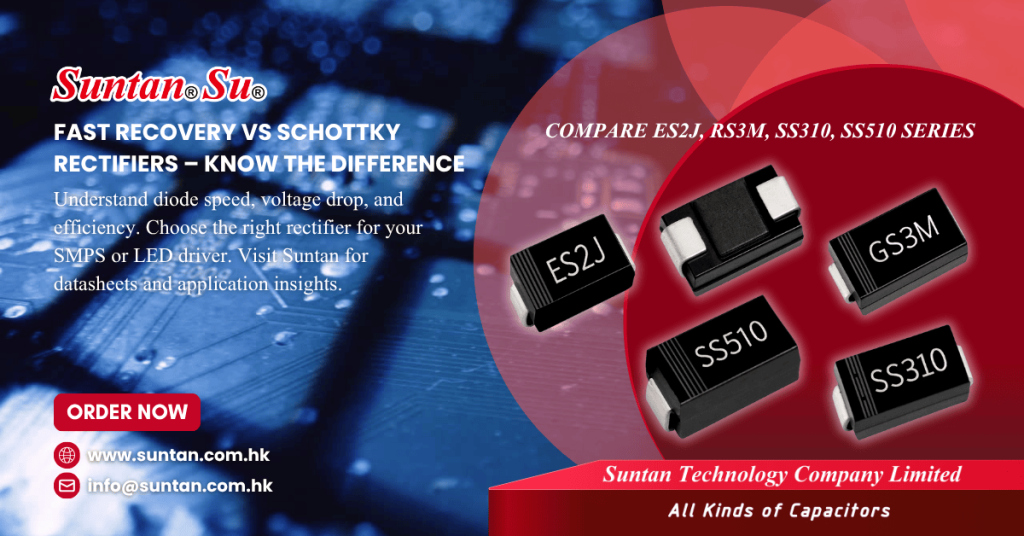
This article explores these aspects in detail using two Suntan examples — ES2J (Fast Recovery Diode) and SS510 (Schottky Barrier Rectifier) — to illustrate how diode physics determine circuit performance in switching and rectification.
1. Reverse Recovery Time (trr) Explained
When a rectifier diode switches from forward to reverse bias, it doesn’t instantly block current. The reverse recovery time (trr) measures how long stored charge carriers take to clear from the junction.
- ES2J (Fast Recovery Type): Typical trr ≈ 35 ns, suitable for high-frequency SMPS and DC–DC converters.
- SS510 (Schottky Type): Has no minority carrier storage, hence virtually zero reverse recovery, minimizing switching loss.
In high-frequency applications such as SMPS or synchronous rectification, a shorter trr directly reduces heat and improves conversion efficiency.
2. Forward Voltage Drop (VF) and Power Loss
The forward voltage (VF) determines conduction loss when the diode conducts current.
- ES2J: VF ≈ 0.95 V at 2 A.
- SS510: VF ≈ 0.45 V at 5 A due to Schottky metal–semiconductor junction.
Lower VF means reduced heat dissipation and higher overall efficiency — one of the main reasons Schottky diodes dominate low-voltage, high-current power designs.
3. Junction Capacitance and Thermal Resistance
The junction capacitance (Cj) affects switching speed and EMI.
- Smaller Cj → faster transient response but higher leakage.
- Larger Cj → better stability but slower switching.
Both ES2J (SMB) and SS510 (SMC) exhibit optimized Cj and low thermal resistance (RθJA), ensuring stable operation under repetitive surge current and thermal cycling conditions.
4. Practical Design Takeaways
| Parameter | ES2J (Fast Recovery) | SS510 (Schottky) |
|---|---|---|
| Reverse Voltage | 600 V | 100 V |
| Average Forward Current | 2 A | 5 A |
| Reverse Recovery Time | 35 ns | <10 ns (Schottky behavior) |
| Typical VF | 0.95 V | 0.45 V |
| Package | SMB | SMC |
Designers typically choose ES2J for higher voltage applications (AC rectification) and SS510 for low-voltage, high-efficiency DC stages.
Conclusion
Understanding reverse recovery, forward voltage, and thermal behavior helps engineers select the right rectifier diode for efficient power design. Suntan’s diode lineup — including ES2J, RS3M, SS310, and SS510 — offers a balance of switching speed, surge capability, and reliability for SMPS, LED, and industrial circuits.
Download technical datasheets:
Watch the related video: Suntan Rectifier Diodes for High-Efficiency Power Conversion
Learn more: www.suntan.com.hk/Rectifier-Diode
Contact Us: info@suntan.com.hk