
Why TSR-Series?
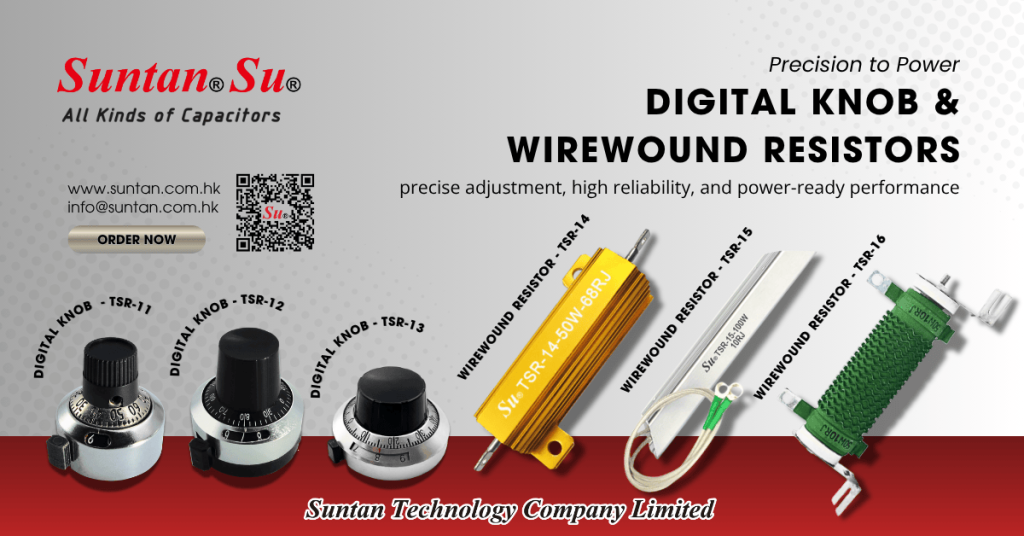
Suntan’s TSR family spans digital knob trimmers (TSR-11/12/13) and wirewound power resistors (TSR-14/15/16). This deep dive focuses on how the parts are built and how that translates into thermal stability, accuracy, and long-term reliability.
Internal Structure: TSR-15 Aluminum-Housed Resistor (Cutaway Overview)
- Element: Nichrome wirewound on an insulating ceramic core for predictable resistance and surge handling.
- Thermal Path: Wire → ceramic core → thermally conductive compound → extruded aluminum case → heatsink or chassis.
- Terminations: Leaded or lug styles for low contact resistance and easy field replacement.
- Dielectric & Creepage: Ceramic form and case geometry maintain insulation at rated working voltage.
- Mechanical: Potting compound damps vibration and improves heat spreading.
Digital Knob (TSR-11/12/13): Precision Control
- Mechanism: Single-turn potentiometer with calibrated dial and detent feel for repeatable set points.
- Use Cases: PSU calibration, sensor bridge balancing, instrumentation zero/span.
Metrology Specs That Matter
- Tolerance: Selectable ranges (e.g., ±5% typical for wirewound values; tighter on trimmers depending on series).
- T.C.R.: Wirewound elements provide low drift with temperature; specify by ppm/°C when ordering critical channels.
- Load Life: Wirewound parts sustain high pulse energy; verify load-life drift vs. operating temperature curve.
- Noise & Linearity: Wirewound ≪ carbon/foil noise; digital knob designs prioritize smooth rotation for fine resolution.
Thermal & Mounting Guidance (TSR-14/15/16)
- Derating is non-negotiable. Follow the power-vs-ambient curve; case temperature, not ambient, controls life.
- Mounting plane = heatsink. Aluminum-housed bodies are designed to be bolted to metal surfaces with thermal grease.
- Airflow helps. Natural convection is often enough for mid-power; consider forced air for continuous high load.
- Hot-spot avoidance. Use multiple resistors in parallel/series to distribute I²R heating and voltage stress.
Reliability Checklist
- Confirm maximum working voltage and pulse energy.
- Define acceptance criteria: ΔR after load-life, humidity, and thermal shock.
- Document torque specs for lugs/bolts; re-torque after burn-in if required.
Download
- Digital Knob – TSR-11
- Digital Knob – TSR-12
- Digital Knob – TSR-13
- Wirewound Resistor – TSR-14
- Wirewound Resistor – TSR-15
- Wirewound Resistor – TSR-16
Contact Us
Clink here or email info@suntan.com.hk for stocked values, custom assemblies (banked kW loads), and quick samples.